The relationship between celebritism and television in Iran dates back to the 1950s, when celebrities were primarily employed for commercial advertising. Over the past seven decades, this relationship has become increasingly institutionalized, with celebrities playing prominent roles across diverse television formats, including drama series, talk shows, talent competitions, and reality-based programs. Against this backdrop, this study examines the theoretical and practical dimensions of celebrity policymaking in Iranian television and proposes a policy framework for governing the relationship between broadcasting institutions and celebrity culture.
Drawing on a library-based review, the study first clarifies the conceptual distinction between celebrification and celebritization and reviews the three dominant approaches to celebrity studies to establish its analytical framework. It then analyzes the organizational structure of television production at the macro, meso, and micro levels and relates these dimensions to the socio-cultural conditions underlying the emergence of celebritism in Iran.
The study proposes policy recommendations at two complementary levels. Contextual strategies address the broader social, cultural, and media environment by emphasizing professionalism over ideological orientation, cultural approaches over instrumentalism, and greater pluralism alongside reduced regulatory centralization. Direct strategies focus on institutional engagement with celebritism through reforming existing governance mechanisms, recognizing celebrities primarily as citizens, and adopting a specialization-based classification of celebrities in media policy and practice.
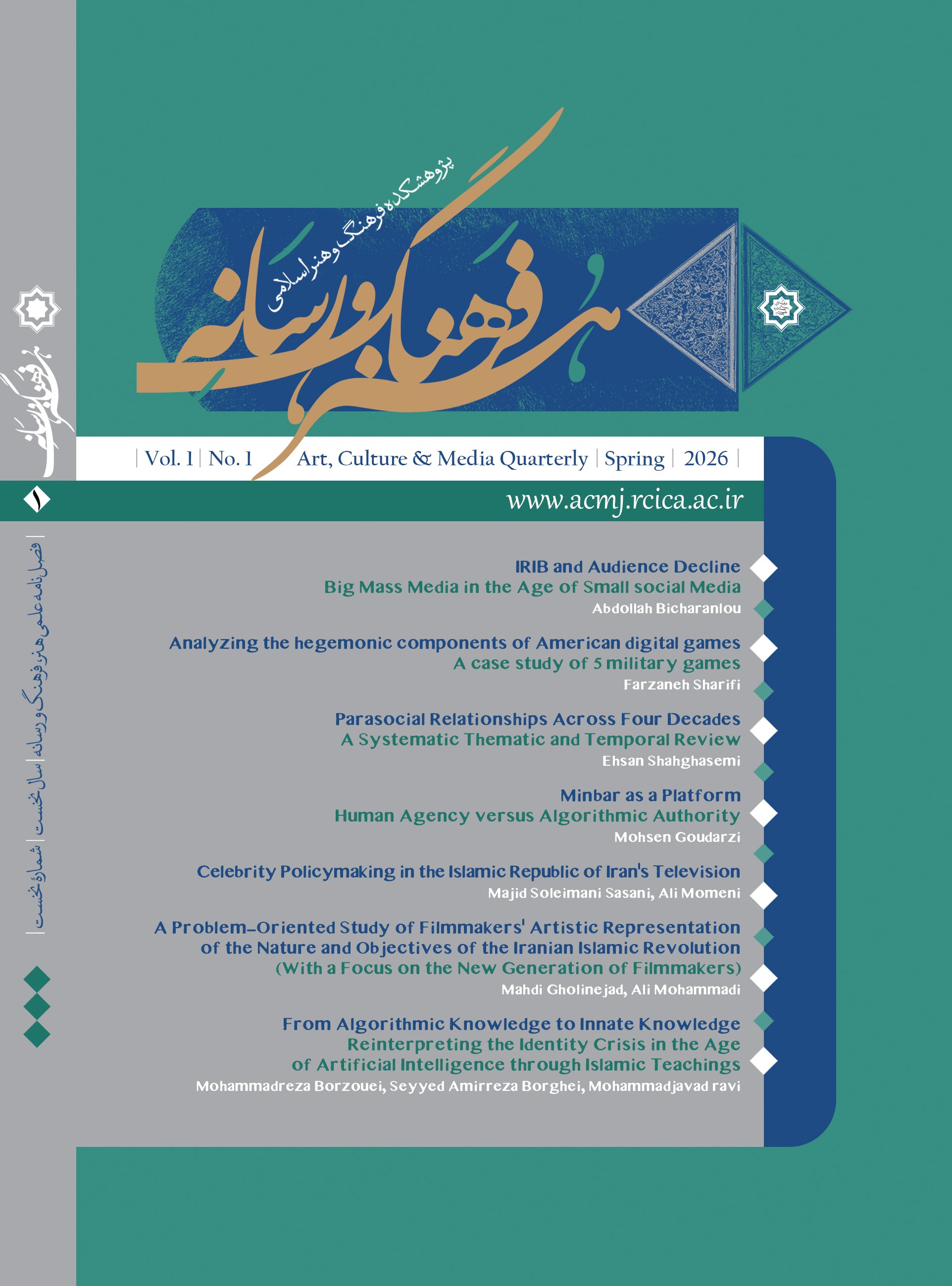
Soleimani Sasani, M., & Momeni, A. (2026). Celebrity Policymaking in the Islamic Republic of Iran's Television. Art, Culture and Media, 1(1), 71-97. https://doi.org/10.22034/acmj.2026.592829.1010
MLA
Soleimani Sasani, M., & Momeni, A. "Celebrity Policymaking in the Islamic Republic of Iran's Television", Art, Culture and Media, 1, 1, 2026, 71-97. doi: 10.22034/acmj.2026.592829.1010
HARVARD
Soleimani Sasani M., Momeni A. (2026). 'Celebrity Policymaking in the Islamic Republic of Iran's Television', Art, Culture and Media, 1(1), pp. 71-97. doi: 10.22034/acmj.2026.592829.1010
CHICAGO
M. Soleimani Sasani & A. Momeni, "Celebrity Policymaking in the Islamic Republic of Iran's Television," Art, Culture and Media, 1 1 (2026): 71-97, doi: 10.22034/acmj.2026.592829.1010
VANCOUVER
Soleimani Sasani M., Momeni A. Celebrity Policymaking in the Islamic Republic of Iran's Television. Art, Culture and Media. 2026;1(1):71-97 (In Persian). doi: 10.22034/acmj.2026.592829.1010

 Art, Culture and Media